 SENAPREP
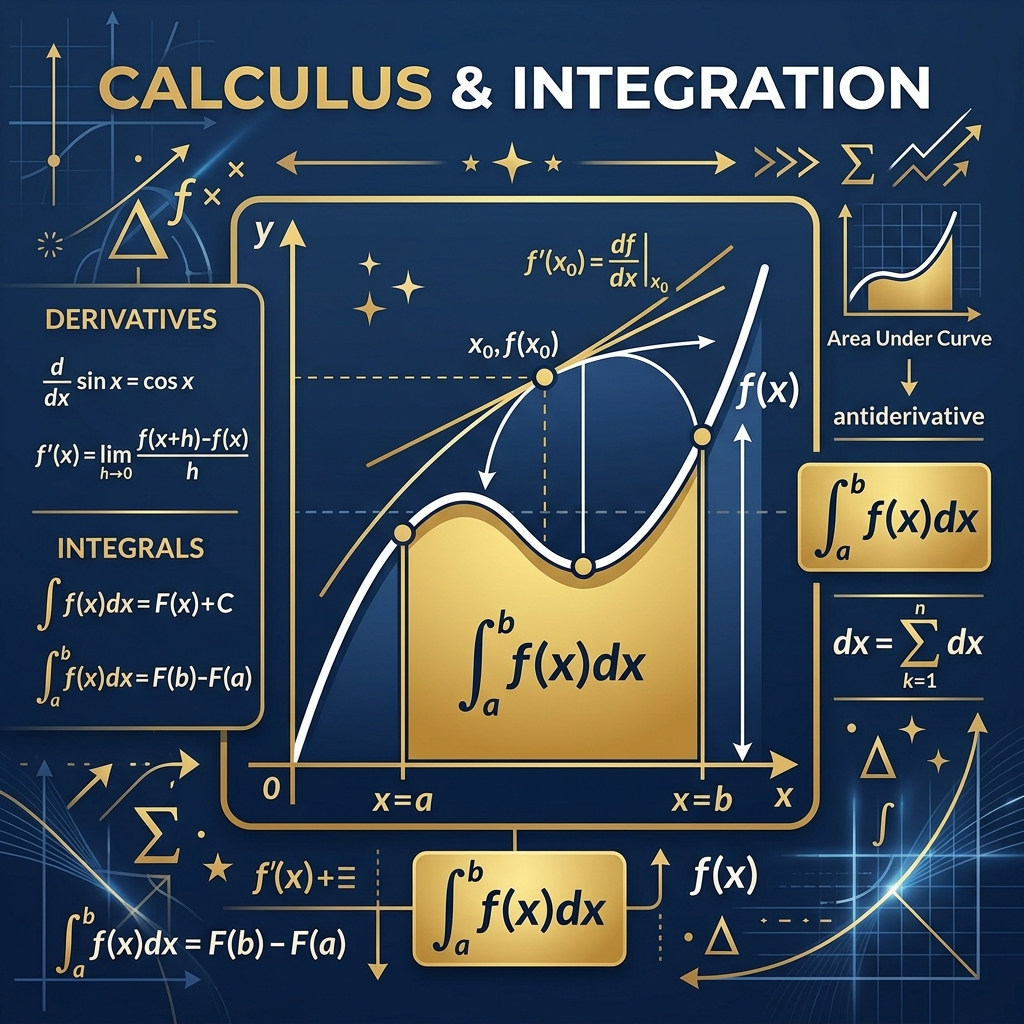
Calculus represents the largest, highest-scoring domain in the UPSC NDA Mathematics syllabus. Spanning Differential Calculus, Integral Calculus, and Differential Equations, this block generates 25 to 35 questions (62.5 to 87.5 Marks) in Paper 1. While many aspirants find Calculus intimidating, UPSC questions in this section follow rigid, repeatable patterns that can be solved swiftly using standard theorems and shortcut rules. Compare this with our NDA Mathematics Weightage Breakdown.
The Calculus Rank Decider
Unlike Algebra where questions can be lengthy, Calculus questions in NDA test conceptual agility. Mastering L'Hôpital's Rule for Limits, the Chain Rule for Derivatives, King's Property for Definite Integrals, and Integrating Factors for Differential Equations will help you solve 80% of Calculus problems in under 60 seconds each.
1. Master Calculus Formula & Theorems Cheatsheet
A. Standard Limits & Indeterminate Forms
- $\lim_{x \to 0} \frac{\sin x}{x} = 1, \quad \lim_{x \to 0} \frac{\tan x}{x} = 1, \quad \lim_{x \to 0} \frac{\sin^{-1}x}{x} = 1, \quad \lim_{x \to 0} \frac{\tan^{-1}x}{x} = 1$ — Practice Limits Questions
- $\lim_{x \to 0} \frac{1 - \cos x}{x^2} = \frac{1}{2}, \quad \lim_{x \to 0} \frac{1 - \cos(kx)}{x^2} = \frac{k^2}{2}$
- $\lim_{x \to 0} \frac{e^x - 1}{x} = 1, \quad \lim_{x \to 0} \frac{a^x - 1}{x} = \ln a, \quad \lim_{x \to 0} \frac{\ln(1+x)}{x} = 1$
- $\lim_{x \to a} \frac{x^n - a^n}{x - a} = n a^{n-1}$
- $1^\infty$ Exponential Limit Shortcut: If $\lim_{x \to a} f(x) = 1$ and $\lim_{x \to a} g(x) = \infty$, then $\lim_{x \to a} [f(x)]^{g(x)} = e^{\lim_{x \to a} g(x)[f(x)-1]}$.
- L'Hôpital's Rule: If $\lim_{x \to c} \frac{f(x)}{g(x)}$ yields $\frac{0}{0}$ or $\frac{\pm\infty}{\pm\infty}$, then $\lim_{x \to c} \frac{f(x)}{g(x)} = \lim_{x \to c} \frac{f'(x)}{g'(x)}$, repeatedly until the indeterminate form resolves.
B. Standard Derivatives & Rules of Differentiation
- $\frac{d}{dx}(x^n) = n x^{n-1}, \quad \frac{d}{dx}(e^x) = e^x, \quad \frac{d}{dx}(a^x) = a^x \ln a, \quad \frac{d}{dx}(\ln x) = \frac{1}{x}$ — Practice Derivatives MCQs
- $\frac{d}{dx}(\sin x) = \cos x, \quad \frac{d}{dx}(\cos x) = -\sin x, \quad \frac{d}{dx}(\tan x) = \sec^2 x, \quad \frac{d}{dx}(\cot x) = -\csc^2 x$
- $\frac{d}{dx}(\sin^{-1}x) = \frac{1}{\sqrt{1-x^2}}, \quad \frac{d}{dx}(\tan^{-1}x) = \frac{1}{1+x^2}, \quad \frac{d}{dx}(\sec^{-1}x) = \frac{1}{|x|\sqrt{x^2-1}}$
- Chain Rule: $\frac{d}{dx}[f(g(x))] = f'(g(x)) \cdot g'(x)$
- Product & Quotient Rule: $\frac{d}{dx}(uv) = u'v + uv', \quad \frac{d}{dx}\left(\frac{u}{v}\right) = \frac{u'v - uv'}{v^2}$
- Logarithmic Differentiation: For $y = [u(x)]^{v(x)} \implies \frac{dy}{dx} = y \left[ v'\ln u + \frac{v u'}{u} \right]$.
C. Applications of Derivatives: Maxima, Minima & Tangents
- Slope of Tangent: $m = \left.\frac{dy}{dx}\right|_{(x_1, y_1)}$. Equation of Tangent: $y - y_1 = m(x - x_1)$.
- Slope of Normal: $m_N = -\frac{1}{m}$. Equation of Normal: $y - y_1 = -\frac{1}{m}(x - x_1)$.
- Increasing / Decreasing: $f(x)$ is strictly increasing if $f'(x) > 0$, and strictly decreasing if $f'(x) < 0$ — Practice Increasing/Decreasing MCQs.
- Local Maxima / Minima: Find critical points by setting $f'(x) = 0$. If $f''(c) < 0$, $x = c$ is a Local Maximum; if $f''(c) > 0$, $x = c$ is a Local Minimum — Practice Maxima & Minima MCQs.
D. Standard Integrals & Definite Integral Properties
- $\int x^n dx = \frac{x^{n+1}}{n+1} + C \ (n \neq -1), \quad \int \frac{1}{x} dx = \ln|x| + C, \quad \int e^x dx = e^x + C$ — Practice Indefinite Integration
- $\int \frac{dx}{x^2 + a^2} = \frac{1}{a}\tan^{-1}\left(\frac{x}{a}\right) + C, \quad \int \frac{dx}{\sqrt{a^2 - x^2}} = \sin^{-1}\left(\frac{x}{a}\right) + C$
- $\int e^x [f(x) + f'(x)] dx = e^x f(x) + C$
- King's Property: $\int_a^b f(x) dx = \int_a^b f(a + b - x) dx \implies \int_0^a f(x) dx = \int_0^a f(a - x) dx$ — Practice Definite Integration.
- Odd / Even Property: $\int_{-a}^a f(x) dx = 2\int_0^a f(x) dx$ (if $f(-x) = f(x)$) and $= 0$ (if $f(-x) = -f(x)$).
- Area Under Curve: Area between $y^2 = 4ax$ and $y = mx$ is $\frac{8a^2}{3m^3}$. Area between $y^2 = 4ax$ and $x^2 = 4by$ is $\frac{16ab}{3}$ — Practice Area Under Curves.
E. Differential Equations
- Order & Degree: Order = Highest derivative. Degree = Power of the highest derivative (when polynomial in derivatives) — Practice Order & Degree MCQs.
- Linear First Order D.E.: $\frac{dy}{dx} + P(x)y = Q(x) \implies \text{Integrating Factor } IF = e^{\int P(x) dx}$ — Practice First Order D.E..
- General Solution: $y \cdot IF = \int (Q(x) \cdot IF) dx + C$.
2. High-Speed Calculus Shortcuts for NDA
Hack 1: The King's Property Direct $\pi/4$ Result
For any integral of the form: $$\int_0^{\pi/2} \frac{\sin^n x}{\sin^n x + \cos^n x} dx = \int_0^{\pi/2} \frac{\tan^n x}{1 + \tan^n x} dx = \int_0^{\pi/2} \frac{1}{1 + \cot^n x} dx = \frac{\pi}{4}$$ The answer is always half the upper limit: $\frac{\pi/2 - 0}{2} = \frac{\pi}{4}$, regardless of the exponent $n$. Try this on our Solved NDA PYQs Archive.
Hack 2: Instant $e^x[f(x)+f'(x)]$ Recognition
Whenever you see $e^x$ multiplied by an algebraic fraction or trigonometric sum inside an integral, differentiate the first term mentally. If the second term matches its derivative, the integral is directly $e^x \cdot \text{first term} + C$.
Example: $\int e^x [\tan x + \sec^2 x] dx = e^x\tan x + C$.


